fbpx Upcoming Events
Live your imaginable.
Research

Author: Raymund Danao

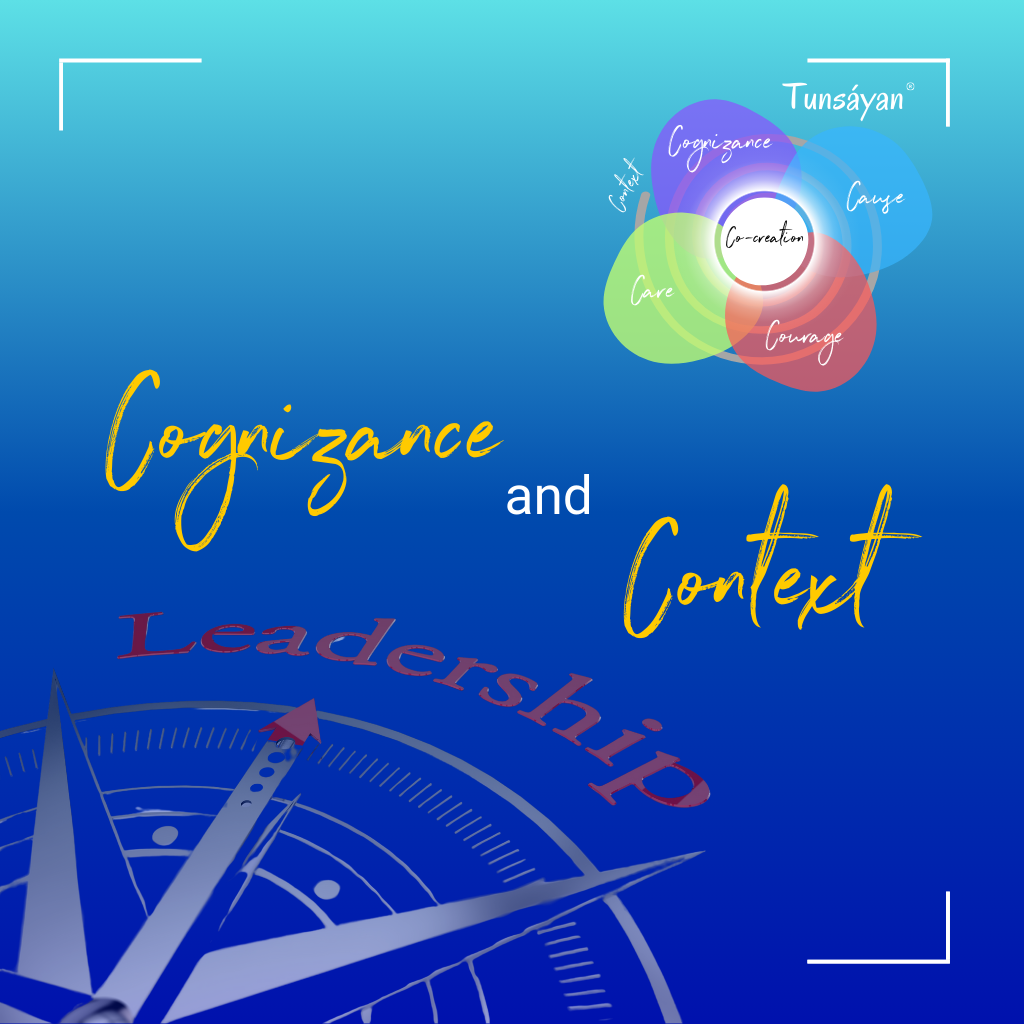
Become the leader you want to be: The Power of Cognizance & Context

In our model for leadership, we cover six practices that we’ve found to be meaningful in taking a human-centered approach. Cognizance, Context, Cause, Courage, Care, and Co-creation. Typically, we begin our exploration with the practice of Cognizance, defined as the practice of raising awareness of our impact.

As leaders, we have the opportunity to create a significant impact on our teams and our organizations. But how aware are we of that impact? Do we know what our inherent strengths are? Do we understand what our weaknesses are? And do we know how these affect the people we work with? In our work with leaders from various levels and companies, the practice of cognizance seems to be the one they would like to improve on the most, so we co-create spaces where leaders feel safe to receive feedback, learn about their values and motivations, and explore how they might bring out better awareness of their team members’ values and motivations as well. It’s not an easy process but the gains we’ve observed have been quite significant. 

What makes the practice of Cognizance so important? According to a study by Showry and Manasa (2014), successful leadership comes about when one is self-aware. Conversely, when leaders overestimate their abilities it is correlated to lower performance (Bratton et al, 2011). Having a more accurate view of oneself and one’s team members is a critical practice which can help us become more human-centered leaders.

Gaining awareness, as previously mentioned, is simply the place to begin. Cognizance without Context may not be as effective. This is the practice of navigating within a system. Having an understanding of what your business environment requires, what your company directions are, and what your team dynamics look like – all play an important role in determining what is required of us as leaders. Any change in these factors may change what is required of you as a leader. Systems thinking has also been linked to leadership performance (Palaima & Skaržauskienė, 2010), where a one-size-fits-all approach may not be the ideal. A good question to ask oneself is how we are continuously seeking to understand the needs of our organization based on the changes occurring both in and out of the company.

Over the coming months, we will dive into the rest of the practices and in the meantime I encourage you to reflect on what you can do in the next few weeks to enhance your practice of Cognizance and Context.

Year-End Reflection: A Step-by-Step Guide for a Brighter Future

As the year comes to a close, it’s a great time to pause and reflect on the journey we’ve been on. Just like a seasoned traveler who takes a moment to admire the view before embarking on a new adventure, let’s take a moment to look back and savor the experiences and lessons from the past year.

The Power of Reflection

Reflecting on the past year is more than just an exercise in nostalgia. In fact, research has found that reflecting on past experiences can help us gain insights into our behavior patterns, emotions, and motivations (Kross & Ayduk, 2010). This self-awareness can lead to increased self-regulation and improved decision-making.

A Deep Dive into Reflection

To maximize the benefits of reflection, consider these questions when looking back at the year that was:

  • What were your biggest accomplishments? Celebrating our successes, no matter how small, boosts our self-esteem and motivates us for future endeavors. 
  • What were your biggest challenges? As humans, it is natural for us to face challenges and setbacks. It is t how we respond to them that shapes our character. Reflect on the obstacles you faced. What did you learn from these experiences? How did you grow as a result?
  • What brought you joy and fulfillment? Recall the moments that brought you happiness and a sense of purpose. Were there specific relationships, hobbies, or activities that nourished your soul? 
  • What areas could you improve upon? We are constantly evolving. Honest self-assessment is a powerful tool for growth. Identify areas where you could develop further. Are there habits you’d like to cultivate, or skills you’d like to enhance?
  • Based on your answers to the previous questions, what themes are coming out? What is most important to you? Our answers point to what we value most; these may help guide us in envisioning what we want to work towards in the future.

Setting Intentions for a Brighter Future

Now that you’ve taken a moment to reflect on the past year, it’s time to set your intentions for the future. We at Haraya have found that goals are more easily and sustainably achieved when we start with a purposeful mindset and clear intentions during goal setting. Some possible prompts to get you started on goal setting:

  • Based on the themes and values that are important to you, what would you like to achieve by the end of next year? It can be helpful to take a moment to envision how your life might be different by then.
  • By the end of next year, how do you want to be different? Sometimes, our goals may not necessarily be about external achievements but about internal growth and development. What needs to change in you to bring you closer to your desired future?

The Science of Effective Goal Setting

Research has consistently shown that setting specific, challenging, and achievable goals can significantly improve performance and motivation (Locke & Latham, 1990). 

When reviewing the goals you have set, consider the following:

  • Specificity: Clearly define your goals. Instead of a vague goal like “I want to be healthier,” aim for a specific goal like “I will exercise for 30 minutes, three times a week.”
  • Challenge: Set goals that push you outside your comfort zone, but are still attainable. Challenging goals can increase motivation and satisfaction.
  • Commitment: Make a conscious cjommitment to your goals. This involves actively visualizing your success and believing in your ability to achieve it.
  • Feedback: Regularly assess your progress. This can help you stay on track and make adjustments as needed.
  • Celebrating Quick Wins:  To help in sustaining momentum, define your quicks wins or checkpoints where you will celebrate your progress. Identify what celebration you will want to do at each checkpoint.
  • Task Strategy: Develop a specific plan of action to achieve your goals. Break down large goals into smaller, manageable steps.

Cultivating a Growth Mindset

A key ingredient for success is a growth mindset, the belief that abilities and intelligence can be developed through dedication and hard work. By embracing challenges as opportunities for growth, you can overcome obstacles and achieve your goals.  

The journey of self-improvement is a lifelong one. Be patient with yourself, embrace the process, and enjoy the ride.

Would you like further support in reflecting on the year that was or would like to have an accountability partner to reach your goals? Our Haraya coaches are here to help. Simply message us via our website or social media channels (@harayacoaching on FB, IG and LinkedIn). You can also directly book a session with our coaches in MindYou.


Sources:

Ayduk, O., & Kross, E. (2010). From a distance: implications of spontaneous self-distancing for adaptive self-reflection. Journal of personality and social psychology, 98(5), 809–829. https://doi.org/10.1037/a0019205

Locke, E. A., & Latham, G. P. (1990). A theory of goal setting & task performance. Prentice Hall.

Bringing Kapwa and Meaningful Connection Into the Workplace

Since I started coaching with Haraya in 2021, and when I started co-producing and writing episodes for The Imaginable Workplace podcast, I’ve thought quite a bit about what makes a workplace feel truly alive. Not just busy or productive, but genuinely alive—with people who feel they belong, who are comfortable showing up as their full selves, and who actually enjoy working together. For me, a big part of that has to do with kapwa, meaning “fellow being” (as opposed to “other”), a concept from Filipino psychology or Sikolohiyang Pilipino.

Kapwa is about recognizing our shared humanity; understanding that we’re all connected. At its deepest level, kapwa is about valuing justice, dignity and freedom, and this is reflected in the intentions and aspirations of maka-kapwang ugnayan. (1) It’s seeing each other as whole people, not just as coworkers or email signatures. Interestingly, “Haraya” in Swahili means pride, dignity, and freedom, which feels like a nice fit for what kapwa is all about, too.

So, how might we create more of this kind of culture at work?

Kapwa: A Different Way of Relating

In a previous article I wrote, I explored how kapwa is an invitation to really see each other—to go beyond the roles and titles, and connect on a human level (1).

When I think about the places where I’ve felt the most connected at work, it’s always been because someone took the time to listen or show a little kindness. It’s about simple things: asking how someone is really doing, or taking a moment to appreciate their specific efforts. These small actions can transform how we feel about where we work and who we work with. 

This also surfaced in some of the conversations we’ve had on the podcast, such as episodes with Jun Cabochan of Pandayan Bookstore sharing his Diwa at Kapwa approach to management (2), and Jen Garcia of Zuellig sharing the simple practice of asking someone how they’re doing, and really asking it again like we mean it. (3)

Connection: The Backbone of Strong, Healthy Teams

In today’s fast-paced and often remote workplaces, meaningful connection can feel like a luxury. But I’d argue it’s essential. When people feel truly connected, they feel safe enough to bring their ideas to the table, to collaborate freely, and to express themselves honestly. 

We can take cues from nature on the value of connection.In nature, “mycelium, the thread-like formation that makes up most fungi, connects roots to one another, allowing plants and trees to communicate with one another to create healthier ecosystems. It forms the largest network — a mycorrhizal network, a “wood-wide web” — beneath the earth.” (4).

When we create an environment where people can speak up, feel that their voices matter and are heard, we strengthen an underground root system that can help us weather storms as a team. That doesn’t happen by accident; it happens when we make intentional space for real conversations, show up with authenticity, and lead with empathy. (5). 

Creating a Culture of Belonging and Wellbeing

Wellbeing is something we often think about in terms of physical or mental health, but it’s also deeply social. In another article, I explored how our wellbeing is connected to the relationships we build and the communities we’re part of (6). When we feel connected to others, we feel more at ease, more energized, and more able to face challenges. This involves a shared practice of pakikipagkapwa

What might this look like?

  1. Start conversations that matter: Make time for real talk—whether it’s during team check-ins or over coffee. Ask questions that go beyond “How are you?” and invite people to share their stories.
  2. Practice mindful listening: It sounds obvious, but really listening—without interrupting or thinking about what to say next—can be a game-changer. It shows people you care about what they have to say.
  3. Celebrate diversity and shared humanity: Acknowledge the unique contributions each person brings, but also find those common threads that connect us all. We all want to feel seen and appreciated.
  4. Lead with vulnerability and care: Whether you’re a leader or a teammate, opening up about your own challenges creates space for others to be themselves too. Small gestures, like checking in or offering help, can also build a culture where people feel genuinely cared for and connected.

As you think about these practices and your own current habits, you can reflect on the following questions:

  • What is my mindset when it comes to connecting with my team?
  • When listening in conversations, do I pay attention to how I’m listening? Do I listen with a focus on myself or my kapwa?
  • What threads connect me with my team? What differences can I celebrate?
  • What does support from my team and my leaders look like to me?
  • What does support for my team and my leaders look like to them?

Moving Forward with Kapwa and Haraya

Embracing kapwa and the spirit of Haraya isn’t about overhauling the entire workplace overnight. It’s about intentional, everyday choices that help us see each other more clearly, listen more deeply, and connect more meaningfully. These values aren’t just cultural concepts—they’re practical tools we can use to create workplaces that are more inclusive, creative, and alive (4); cultures where we co-vision our imaginable workplace and co-create it with purpose and consistency over time. 

What might cultivating this kind of culture unlock for you and your organization?

Learn more about how to make your imaginable workplace a reality with Haraya’s organizational transformation programs for leadership, culture-building and wellbeing here.

***

Jen Horn is a facilitator, coach and writer, born and raised in the Philippines. She cultivates connection through spaces for reflection and conversation on @pagbubuo, as co-creator of Ugnayan Cards, as chapter lead of Culture First Manila, and as a facilitator of leadership and culture-building programs for individual and organizational transformation. Her curiosities and practice lie in the intersections of culture, creativity, and the wellbeing of the individual, communities and the natural world. Learn more about her work via bit.ly/jenhorn.


Footnotes:

  1. Horn, J. (2024a). Pagbubuo ng Maka-kapwang Ugnayan: A framework for meaningful connection. Pagbubuo with Jen Horn on Substack.
  2. Joven, M. & Horn, J. (2023) Courageous feedback grows high-performing teams. The Imaginable Workplace podcast.
  3. Joven, M. & Horn, J. (2022) Imagine an office that supports your mental health. The Imaginable Workplace podcast.
  4. Horn, J. (2024b). Kapwa at Ginhawa: Expanding our circles for collective wellbeing. Mga Liham ng Ugnayan on Substack.
  5. Horn, J. (2024c). Pakikipag-Ugnayan: On returning to authentic and meaningful connection. Pagbubuo with Jen Horn on Substack.

Horn, J. (2024d). The Pursuit of Flourishing: A holistic understanding of happiness and wellbeing. Pagbubuo with Jen Horn on Substack.

Mund

Connect with Mund

Schedule a Consultation

TRANSFORMATIONAL COACH

Hi!   I’m Mund

I am a Professional Certified Coach (PCC) accredited by the International Coaching Federation (ICF). I am an experienced Leadership, Career, and Life Coach who works with individuals, leaders, and teams to reach their professional and personal transformational goals. I create a safe and brave space to foster self-expression and understand where my clients come from so I can help them move forward confidently.

As the Digital Coaching Lead for Haraya, I manage our relationships with key enablement partners in technology, assessments, and mental well-being platforms. I am also one of the mentors for our Human-Centered Coach (HCC) Certification program and runs our Coaching Fundamentals workshop for leaders in organizations.

Apart from Coaching, I’m also a financial literacy advocate, church community servant, and supporter of numerous non-profits. Ultimately, my life purpose is to “inspire and empower others to live a life that is significant for them.”

More about Mund

Connect with Mund

Schedule a Consultation

MEET THE COACHES

jackie.caniza@harayacoaching.com
Jackie

Rosan

Connect with Rosan

TRANSFORMATIONAL COACH

Hi!   I’m Rosan

I am an experienced executive coach, with 20+ years of experience in corporate leadership. I help aspiring executives and leaders reach their personal career goals by helping them find ways to leverage their strengths and uncover unhealthy patterns that get in the way of their personal progress. My coaching style is to encourage openness, authenticity, and gently challenge my clients’ long-held beliefs that may be preventing them from moving forward. My goal is to help my clients achieve their personal leadership goals and live fulfilling work lives.


In addition to being an executive coach, I am also a senior learning consultant and facilitator on leadership, personal branding, sales, critical thinking, and strategic planning. Through my work, I help empower leaders to become their best selves.

More about Rosan

Connect with Rosan

MEET THE COACHES

jackie.caniza@harayacoaching.com
Jackie

Jen

Connect with Jen

Schedule a Consultation

TRANSFORMATIONAL COACH

Hi!   I’m Jen

In all Jen does, she seeks to cultivate connection with one’s self, others and the world towards a more mindful, authentically expressed life, and a more connected and compassionate world.

As a facilitator and ICF Associate Certified Coach (ACC), Jen supports various individuals, teams and organizations in working towards their own and collective wellbeing and resilience through transformational, human-centered coaching programs with Haraya Coaching and her own coaching practice.

Her work as a facilitator, coach and learning designer, along with her value for creativity and connection led her to create Ugnayan Cards in 2023, a tool to support anyone interested in cultivating connections with one’s self, others and the world through meaningful and liberating reflections and conversations.

As a researcher and writer, she also co-produced two podcasts, The Imaginable Workplace, which aims to reimagine and co-create better places to work (now on its second season), and Muni on This, which resulted in 18 episodes of various creatives working towards a more mindful, equitable, livable world.

Her value for connection also compels her to bring community together — as current chapter lead of Culture First Manila, a global community of people geeks who dream of a better world of work, and previously as chief collaborator of Muni.

She continues to integrate, distill and share research and reflections about wellbeing, creativity, culture, connection, wholeness and more through her newsletter, Pagbubuo at jenhorn.substack.com.

She is currently learning more about expressive arts facilitation with The Arts and Health Institute, as well as somatic coaching of The Power of Embodied Transformation with Coaches Rising.

She completed her core and advanced coach training certifications from Coach Masters Academy, team coach certification level 1 from Leadership in Motion, and most recently, her human-centered coach certification from Haraya Coaching.

She received a Chevening scholarship in 2018, and completed her MSc in Sustainable Development with distinction in 2019 from the University of Surrey in the UK, where her research focused on developing a framework for understanding the personal motivations of sustainability leaders in the Philippines. She also completed her BA in Psychology with honorable mention in 2006 from De La Salle University, Manila.

More about Jen

Connect with Jen

Schedule a Consultation

MEET THE COACHES

jackie.caniza@harayacoaching.com
Jackie

Von

Connect with Von

TRANSFORMATIONAL COACH

Hi!   I’m Von

I am a licensed psychologist who takes an integrative, non-pathologizing, and emancipatory approach to psychotherapy. My practice is trauma-informed, trauma sensitive, influenced by liberation psychology, and is primarily rooted in the current scientific and humane understanding of how we survive and navigate our respective social contexts.

This allows me to help individuals understand what is happening to them first, rather than automatically come from a position that there is something to be fixed in them.

I mostly work with adult (both gender conforming and gender non-conforming) clients needing help in managing depression, anxiety, and a wide range of adjustment concerns.

More about Von

Connect with Von

MEET THE COACHES

jackie.caniza@harayacoaching.com
Jackie

May

Connect with May

TRANSFORMATIONAL COACH

Hi!   I’m May

I help high performing people and teams prioritise what is essential to their success through Executive and Career Coaching. My experience in local, regional and global roles allow me to become a deep listener and empathic partner to my clients.

As a mindulness practitioner, my coaching practice is infused with mindfulness principles helping my high perfoming clients achieve better and with ease. “Mindfulness gives you time. Time gives you choices. Choices skillfully made lead to freedom.”

I enjoy cooking for my friends and family, tending to my small garden, and going on early morning hike followed by a lovely meal after.

More about May

Connect with May

MEET THE COACHES

jackie.caniza@harayacoaching.com
Jackie

Vives

Connect with Vives

Schedule a Consultation

TRANSFORMATIONAL COACH

Hi!   I’m Vives

I am a mother of 2 millenials and 2 zinnials, married to a veterinarian and has a 4-year old grandson. I am a trained and certified coach by Coach Masters Academy of Singapore. I coach on matters regarding leadership, team development, career, life and wellness.

With over 26 years of corporate life, the 7 last years of that in the global leadership role for people and organization development for a multi-national, I have experience in various Human Resource development areas and Supply Chain management. In the past decade, I had worked with both private and government sectors in a consulting role. Some of the government agencies were DepEd/NEAP, DTI, DAR, DAP, DICT, CSC, CSI, PPP, PPC.

My social mission is to help a person bring out the best in himself and my spiritual mission is to bring the love and compassion of God to the people I encounter daily.

More about Vives

Connect with Vives

Schedule a Consultation

MEET THE COACHES

jackie.caniza@harayacoaching.com
Jackie

Binggay

Connect with Binggay

TRANSFORMATIONAL COACH

Hi!   I’m Binggay

With combined experience as consultant and HR practitioner, I focus on talent management and organizational development. Working with clients from varied industries such as the acedeme, government, financial, management consulting, BP,O energy and FMCG has provided breadth of experience. As a certified Coach, I find fulfillment partnering with clients (individuals from various levels in the organization and teams) in managing leadership, career, life and transition challenges.

I am driven to serve and have initiated and spearheaded outreach and psychological support programs in the work place and continue to coach and facilitate programs on a voluntary basis.

I completed a degree in AB Psychology at the Ateneo de Manila University and completed academic units for its Mastersal degree in Industrial-Organizational Psychology. I am also a trained/certified assessor of the Development Dimensions International (DDI) and SHL. With an accreditation at Harrison Assessments for Employee Development, I have also completed its Debriefing and Coaching Series in preparation for certification.

Connect with Binggay

MEET THE COACHES

jackie.caniza@harayacoaching.com
Jackie