I am the lead for the Banyuhayan (Wholeness) and Ka-Aruga (Family) Coaching Programs of Haraya Coaching. I am a seasoned Life and Leadership Coach with over 500 hours of coaching experience.
I believe that coaching is a tool to unlock the potential inside each individual. I have helped clients get clarity on various topics such as making career decisions, managing transitions, and achieving balance.
Aside from being a coach, I am an Organization Development Consultant with over 15 years experience and hold a Masters in Industrial-Organizational Psychology. I use a coaching approach to help organizations and leaders create relevant, sustainable and people-centered solutions.
A parent myself, I am the founder of The Parent in Progress, a community with over 10,000 members, that empowers parents to make the best decisions for their own families. I am passionate about building a kinder, more joyful world for ourselves and for our children – one meaningful conversation at a time.
Vina is a credentialed professional coach by ICF (International Coaching Federation) and is currently Senior Director for Wellness and Resiliency for TaskUs, leading a team 50 Senior Managers and Professional Coaches supporting more than 42,000 Teammates across Asia. Prior to this role, Vina was an Independent Executive and Leadership Coach and Organization Development Consultant for more than 4 years serving multiple industries. She has more than 30 years of extensive experience in leadership, organization development, and learning – strategizing and implementing organization-wide initiatives and programs that support the business. She has designed and led the execution of learning and development programs for different leadership levels across different organizations (outsourcing, shared services, information technology, software engineering, academe, manufacturing, and financial services).
Posted by: Jackie Sarmiento Cañiza, Certified Coach | PCC, CNTC | Posted on . Posted in Journal.
Share:
My fascination with neuroscience began over a decade ago when I was attending a Leadership program at MIT. One of our professors happened to be a neuroscientist and I thought it was interesting that she would be teaching a leadership class. I’ve attended many leadership programs before then but I hadn’t come across anyone talking about it from a scientific view. But once the lectures started, it made perfect sense. Leaders have a big influence on people’s thoughts, emotions and behaviors – to the point of driving success or failure of teams or organizations. I thought it was a great way of learning more about leadership, to understand the neuroscience behind our decisions, feelings and actions. I was hooked. Every opportunity I could find to learn more about the brain and nervous system, I invested in. I loved having a deeper understanding of what makes leadership attributes work and knowing what happens in our bodies as we respond to leadership stimuli. In my pursuit of more knowledge, I realized how our practices as leaders and coaches need to be better-grounded on science and research, and not just on the latest book that comes out with a cool or punchy title (although I have to admit I’ve enjoyed reading some of them). While these may be useful, it would be even more useful if we understood why these principles work and when they work by looking at the human mind.
For example, I learned that:
through a process called neuroplasticity, leaders can help themselves and their team members grow and develop in more meaningful ways;
having a sense of purpose promotes brain health and better wellbeing; and
experiencing things together with our teams synchronizes our brains and makes us feel more connected.
These are just some of the many insights I’ve gained from studying the nervous system. So, together with my team, we embarked on a journey to ground our Haraya practices with even more data, science and research. We are constantly gathering inputs, from the latest studies to on-the-ground insights our clients openly share with us. By combining these sources of information, we feel more confident in sharing our models and frameworks with the coaches and leaders we work with.
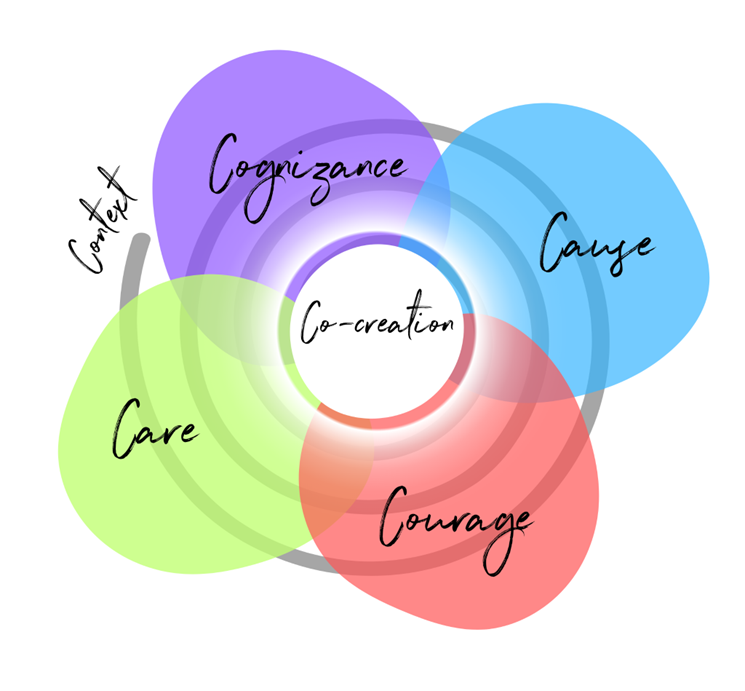
Our leadership model, for example, was brought together through deep conversations that we had with clients when the Covid pandemic first hit. We thought it would be a relevant model just for that period, but our research and data told us that these practices are very much useful beyond that time. It has continuously evolved together with our team’s ongoing learning, and we now have 6 solid leadership practices that we share:
We call it our Tunsayan model. It’s a play on two FIlipino words that mean authentic (tunay) and practices (sanayan). Through this model, we hope to answer the question, “How do I practice leadership in a way that honors my authentic self, the authentic selves of the team members I work with, all while meeting the needs of the organization I am a part of?”
As we work with more and more leaders and teams, we continue to learn about these practices and how they help. But just like scientists, our curiosity keeps bringing us new and different discoveries. For now, we are happy with what we know so far and even happier to share it with anyone who is as curious as we are.